 |
 |
  |
 |
  |
 |
 |
|||
 |
 |
 |
 |
 |
||
| reference articles | competition journal | piping links | FAQ | contact me |
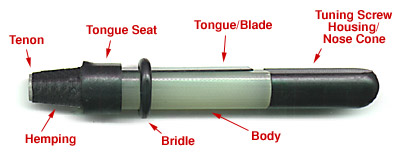
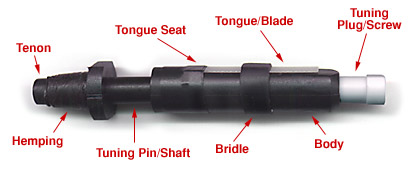
Andrew's Bagpipe Tips: Adjusting Drone ReedsBy Andrew T. Lenz, Jr., Santa Cruz, California, ©2004-2011Drone reeds, while a mystery to some, are actually not that difficult to adjust to be more efficient, more reliable, and allow proper tuning pin positioning. This page will discuss drone reed adjustment and help you set your reeds for your pipes. While focused on synthetic drone reeds, the basic concepts apply to cane reeds as well. The parts.Drone reeds come in a wide variety of different brands and designs. (See my Drone Reed Identification page for all the different models.) Most have some means of changing the length of the air column (tuning screw/plug or tuning shaft), others don't. They use different tongue materials, different body materials, different bridle materials. What they do have in common is they will all have a tongue (the vibrating surface that makes the sound), a bridle (which slide up and down the body to change the effective tongue length), a main body and some sort of tenon (some hemped, some with a rubber sleeve) which is inserted into the drone's reed seat. Here are a couple example reeds with the parts labeled. Note that in this case, the top reed has an internal screw, but on many reeds this might be an external screw instead.
When to adjust.A night or two before a big performance is probably not the best time to experiment with your reeds on a whim. But if your reeds are not working, then yes, it's a good time! Otherwise, it's better to wait. Go ahead an experiment. Don't worry that you won't be able to get your reeds back into functional order if you overdo a change. And you aren't going to hurt your reeds by moving around the bridle or a tuning screw, for instance. (Though springing a tongue has a certain amount of risk, but that's covered below.) If you'd don't try new things, you don't learn. A number of reed makers recommend playing their reeds for a while to break them in before making any judgements regarding their tonal and performance qualities. It's not a bad idea to allow any new reed some time to "settle in" for a dozen hours or so of playing, though some reeds may be ready to go out of the box. What does this mean? After a couple weeks of playing a new set of reeds, revisit the reeds and take a look at perhaps making some little adjustments. How to begin.When setting your drone reeds, your number one stop is setting the blowing pressure, followed by adjusting the pitch so your drone tops are in a good position on the tuning pins. From there you may further tweak the reeds to better match your ideal sound. First, we are going to cover the different adjustments that you can make. The Effects of Different Adjustments.First off, understand that individual adjustments don't exist in a vacuum. They may have several different effects at one time. For instance, moving the bridle up to lengthen the tongue will: make the reed flatter, less air efficient, make the reed's sound texture less smooth, make the reed a little louder, make it a little easier to strike in and make the drone tune lower on the pin. Got all that? Don't worry, it's discussed at length below. Point is, changing one thing will probably alter more than one characteristic of your bagpipe setup. The trick is knowing if a side-effect is going to create a problem for you or not—some are very minor side-effects, others are more pronounced. The amount of effect will vary from reed design to reed design. Bridle: It's very important to note that even minute changes to the position of the bridle can have very dramatic effects. It's not a bad practice to mark the body of the reed—something non-permanent like a pencil, unless you want it there indefinitely!—to indicate the initial position of the bridle. O-ring bridles sometimes rotate back to their original position, so a mark can be very useful. For a broad rubber bridle, you will want to keep the bridle even around the body, that is, you don't want the top side in one position and underside of the bridle offset forward or back from that position. All other things being unchanged, if you move the bridle down (away from the seat), in order to maintain the same pitch on a drone, your drone pipe needs to go "up" or lengthen. If the bridle goes up toward the reed seat, the drone length needs to be shortened. If you have a drone reed with no independing tuning adjustment (such as cane reeds) and, say, you want to increase the resonance in your drone by increasing the chamber size (lengthening in the drone and flattening the sound), you need to move the bridle down (sharpening the reed) to balance or maintain the same drone pitch. Shorten tongue + lengthen drone = same drone pitch* Lengthen tongue + shorten drone = same drone pitch* *Assuming the offsets are in balance. If you lengthen the tongue a lot and shorten the drone a little, the drone pitch will be flatter. You get the idea. Tuning screw/plug/cone or tuning pin/shaft: Reduce the size of the sound chamber of the reed and raise the pitch by:
Increase the size of the sound chamber of the reed and lower the pitch by:
Hemping the reed's tenon: Pulling out the tongue: Wax/Tape on tongue: Springing the tongue: Hair under the tongue: Getting the Ideal Tuning Pin PositionFirst off, what constitutes "too high" or "too low" on the tuning pin? Optimally, a drone top should tune between the hemp line (covering the hemp) and about 3/8" (9mm) above it. Too high and the drone top might fall off or rock back and forth and possibly cause erratic tone. Too low, and you collapse the sound chamber of the drone and sacrifice tonal quality. The precise position will depend on your pipes, drone reeds, and how you play. Drone top tuning too high (reed pitch is too sharp).
Drone top tuning too low (reed pitch is too flat):
Reed Won't Sound.If you are finding that a drone won't sound at all, most likely too much of the hole under the tongue is being covered. 1) Move the bridle up a tiny bit (more tongue to vibrate). *Alternatively, you can strike up your full set of pipes, but the above method is quicker. (Though it's easy to gag on a bass drone reed.) If once you've set the bridle to where you think it's about perfect, walk away for a few minutes then come back and pick up the pipes and strike-in then play as you would for a performance. This will give you a better idea of your true playing pressure. In a pinch, you can place a hair under the tongue next to the bridle to get a reed to sound. Reed Cutting Out.If you are finding that a drone is shutting down and won't continue to play, it can't handle the pressure that you are putting into the bag. 'Almost guaranteed never to cut out' method (less air efficient)*: 1) As hard as you can, with the drone out of its stock, mouth-blow—no slobbering!—the offending reed while it is seated in its drone. 'Very unlikely to cut out' method (more air efficient)*: 1) Move the bridle up (more tongue to vibrate). The 'experienced blower' method (most air efficient)*: 1) Move the bridle up on the offending reed (more tongue to vibrate). *If your reed tongues get very wet, they may defeat any attempts to prevent accidental shut down. You can also try placing a hair under the tongue, if time is very short. Yet another option, if you have a synthetic bag, would be to install a drone valve to slightly restrict airflow and also slightly reduce likelihood of accidental reed cut-out from overblowing. (See my Drone Valve Identification page.) Reed squeaks or squeals.If you find a reed is squealing on strike-in or during performance, lengthen the vibrating surface of the tongue by moving the bridle up toward the seat.Alternatively, if you have a synthetic bag, you can install a drone valve to slightly restrict airflow and prevent the drone reeds from . (See my Drone Valve Identification page.) Chanter sounds before or at the same time as the drones.You want your drones to sound prior to the chanter coming in. If they don't, either they are set too hard or your chanter reed may be too weak. Assuming that your chanter reed is what you want, for each drone reed you will want to shorten the vibrating surface of the tongue by moving the bridle away from the seat. Again, use small incremental changes in the bridle position and test after each change. Reed Too Loud/Too Quiet.Too Loud: If you are finding that your drones are overwhelming your chanter reed (and you don't want to change your chanter reed), then you'll want to reduce the volume of your drone reeds. The longer the tongue that is vibrating the louder the reed will be, so to reduce the volume, you'll want to move the bridle away from the reed seat to shorten the tongue. In order to balance this pitch-sharpening change, you will flatten the reed by lengthening the sound chamber of the reed. Another method, though less common is to tape over part of the opening under the tongue, farthest from the reed seat, using a thin tape. (Thick tape can interfere with the tongue vibration.) This technique will also make the reed more efficient. Risking reed "drop out", seating your reeds shallower in the reed seat will make the reeds a bit quieter. Yet another method would be to add a layer (or several layers) of tape to the inside of each drone bush to reduce the opening size and drop the volume. This is not very common. Too Quiet: If your chanter is overwhelming your drones or you otherwise want louder drones, lengthening the tongues on your reeds will help. Also if you can, pushing your reeds deeper into the reed seat will make the reeds a bit louder. Making your reeds more air efficient.Under the tongue of a synthetic reed is an opening in the body. As you move the bridle down the tongue (away from the reed seat) this opening is effectively reduced in size, allowing less air to pass through the reed, making it more efficient. Blowing less air is great, but just remember, the less tongue to vibrate the more risk of your reeds cutting-out due to blowing too hard. It's a matter of balance. To make a reed the most efficient, you should move the bridle down away from the reed seat until the reed shuts down, then work the bridle slowly up, testing along the way, until it sounds. Then test the reed to make sure it is reliable at your blowing pressures—your blowing pressure is determined by the pressure required to keep your chanter reed sounding. Remember, your drone reeds may shut down and therefore need further adjustment if you change your chanter reed from a softer reed to a harder reed. After shortening the active area of a tongue, it's always a good idea to make sure you reeds won't shut off too easily from over blowing. Strike up your pipes and blow as hard as you possibly can. If a reed cuts out, move the bridle back up to free up more of the tongue. If you know that you have good breath control and won't drastically overblow, you may find that this test is unnecessary and that, in fact, if you are a steady blower, you may wish to have your reeds cut out if you blow that hard. You sacrifice some efficiency for the security of knowing your reeds won't cut out from overblowing. All of your drone reeds should cut out at approximately the same time when overblowing. Less commonly, like the method used to quiet a reed, thin tape can be placed over part of the opening under the tongue, covering the edge farthest from the reed seat to also make a reed more efficient—and quieter. The other thing to keep in mind is moisture. Your reeds will behave differently after condensation has built up around/under the tongues. You should play your pipes for a while and see how the reeds behave and adjust accordingly. You may find that you need to open up your tongues a bit. Also know that your drone reeds are expected to allow air to escape from your bagpipe when you are inflating the bag prior to strike-in. This is completely normal, and in fact, is a necessity!
Reed Too Buzzy/Not Buzzy Enough.People like different textures to their drone sound. Some like a "motor boat" sound. Others like a more even, less buzzy sound. Not buzzy enough: Move the bridle down to shorten the tongue so it's more controlled. You can also try adding more hemp to your reed so it seats farther out of the drone, just don't add too much! Too buzzy: Move the bridle up to lengthen the tongue, so there's more room under the end of the tongue. You can also try seating your reeds deeper if there is room. Trailing drones/Unclean cut-offs.Trap system: No trap system: Bass Drone Strike-in Troubles.The drone that typically gives people the most trouble striking in is the bass. Often the problem—aside from just bad technique—is the drone tuning too high on the lower pin. Move the top section of the bass so 1/4" (6.5mm) of the hemp showing and move the bottom joint down so there is only about 1" (2.5cm) to 1-1/4" (3.2cm) showing of the tuning pin. This means you will have to lower the pitch of the reed by some means—moving the bridle up, tuning screw out, etc. You can also try to move the bridle up toward the seat to length the tongue a bit, this often will help. Or you can try a bass drone reed with an inverted tongue. Inverted bass drone.It's been found that an inverted bass drone tongue can help reduce the chance of howling at strike-in. However, this orientation adversely affects the tonal quality of the bass drone somewhat, in that, the reed will typically be a little quieter and possibly higher pitched as well. Some makers offer an inverted bass reed as an option. Mark Wygent makes a series of reeds can be inverted at the whim of the piper. Jean Allioux makes a special air inverter sleeve for his standard tongue orientation bass reeds to get around any strike-in air flow problems. Safety HarnessSome pipers advocate securing a drone reed via a hemp noose to prevent it from dropping into the bag, even if it does fall out of its seat. This is accomplished by knotting some hemp (or dental floss which is thinner—or even heavy thread) around the base of the reed then feeding the remainder strand along the side of the hemping where the drone secures into its bag stock. Voila! No fishing around in the bag for a lost drone reed. On the other hand, I've lost a reed only once into my bag in my piping career which occurred after installing some new reeds. Another more invasive method is to get a tool and thread the reed seats of your drones. This will allow you to actually screw in your drone reeds very securely. Make sure the walls are thick enough to still provide enough support after thinning them by threading. I might think twice before altering a collector's set of pipes in this manner though. Some pipers have had success using substances with adhesive properties to help prevent kamikaze reeds. One is "peg dope" which used by violinists to keep their tuning pegs from slipping. Another is "Tincture of Benzoin" which is a mild skin adhesive available at most pharmacies. Either of these can be applied to the base of the reed. I know a number of pipers who've never lost a drone reed into their bag without any special securing of any kind. Personally, I don't bother, but if you find that you are losing your reeds frequently and want some insurance, go ahead. (But do hemp up your reed too, so it seats more firmly!) Keep an eye on your hemp.Check to make sure that your hemping hasn't drooped over the opening into the drone. Sometimes the end wrapping can come loose and hamper air moving from the reed, much like what you can also run into with a chanter reed. You want that passage free and clear. If you are not using the hemping that came with your reeds—or need to use something in addition—it's best to use something sticky, i.e. black waxed hemp over plain yellow hemp. Some people use dental floss and some use Teflon tape. If so, just make sure it's really snug. Why they just may don't sound right.Bagpipe drones are all different. People are all different. Reeds are all different—tongue (material, length, thickness, width), opening beneath the tongue, reed bore, body (material, body thickness, dimensions), air column adjustment method (if at all) and more. There's a triangle of those three things that need to match up to have a happy piping situation: drones = piper = reeds. Say you have designed the world's most cane-like synthetic drone reed. Someone buys your reeds, and since their old pipes have drones with a narrow bore* and they are playing a high pitch for their band, they have to move the tuning screw/plug way out and still move the bridle down. The piper complains that your reeds are too quiet or shut down too easily. Another piper with a newer set of pipes loves your reeds. As does different band piper. Some combinations are just not going to work out as well. Try different reeds until you find one that's the best for you. *Yes, narrow bores in the lower section of a drone make for a lower pitch. Conversely, a wide bore makes for a high emitted pitch. Seems counter-intuitive, but it's the truth. But, a narrow bore in the top drone section makes for a higher emitted pitch. Acoustics can be a strange beast. Reed MaintenanceAfter each playing session—or during a break in a long performance—you should swab out under the tongues of your reeds with a thin piece of paper. (A piper I know keeps a small pad of "Post-it Notes" in his pipe case for this use.) Once in a while, it probably wouldn't hurt to carefully wipe out your drone reeds with a slightly moist cotton swap—don't force it though! Some pipers go to the extreme of completely removing their drone reeds after each piping session and storing them. Taking reeds in and out is going to compress the hemping and could lead to the reed dropping out when you least expect it. If you opt for this method, I'd recommend at least consider the safety harness for your reeds discussed above or be very aware of how they are seating. Reed DeathReeds do eventually wear out. In particular the tongue, which bends back and forth about a million times for every hour of playing. (And you wonder why reeds may break in?) Though even with the abuse, tongues can last for any number of years depending on the material. Some reed makers offer a tongue replacement service, though some reeds are easily changed by the end user. If you reeds are just not sounding the same and you've cleaned them thoroughly, and you can't get the tongues replaced, it might be time to fork over the money and buy a new set. Closing thoughts.Remember, there is no one perfect reed for everyone, but with a little bit of know-how, you can get the best out of the reeds you've chosen. You may also be interested to read Jim McGillivray's article on drone tuning elsewhere on this site.
This page last updated Saturday, September 10, 2011. |
| sitemap | ||
 |
 |
||
 |
|||

